Executive Function Coaching: What Detective Work Looks Like With a Stuck Student
This week was our first week of the Decode Boot Camp. As we spent time inside the decode map, the tool that eventually becomes each coach's companion sheet for working through a case, we focused on the detective branch of the The Executive Function Interpretive Coaching framework.
To make it real, I brought in a current student. Let's be honest: she's stuck. Which means, for a while, I was stuck too.
If I were an inexperienced coach, or one who hadn't been trained in executive function, I could have easily stopped at the surface. Failing grades. Missing assignments. Case closed, in a sense: struggling student, needs to try harder. But because I have a relationship with her, and because I use the interpretive coaching framework, I was able to look past that and figure out my actual next step. For her, the most important thing right now isn't the missing assignments at all. It's making sure her psychiatrist is getting the right information.

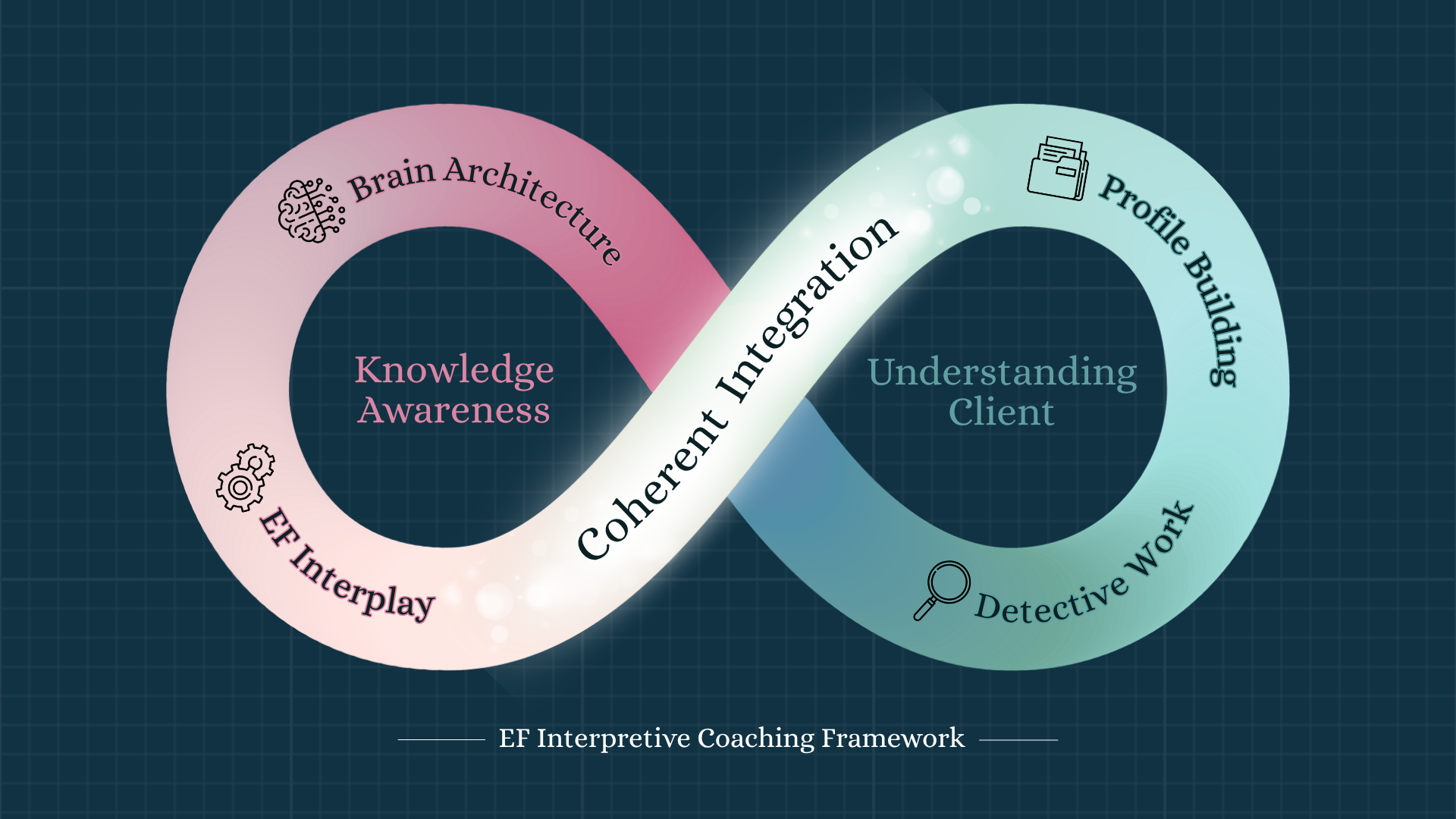
The Executive Function Interpretive Coaching framework I teach is shaped like an infinity loop, and it's built around a simple but uncomfortable idea: we are not allowed to pick a strategy or tool right away.
On the left side of the loop is knowledge gathering: brain architecture, executive function interplay, the science of how attention, memory, and regulation actually work together. On the right side is client information: building a profile, doing the detective work, understanding this specific student in front of you. Only when both sides have been done does the loop bring you to coherent integration, the point where you're finally equipped to choose a strategy that fits.
Most coaching, even well intentioned coaching, skips straight to that last step. A student is missing assignments, so we build a planner system. A student is failing, so we tighten accountability. It feels productive. Sometimes it even works. But it's picking a tool before doing the work, and when the tool doesn't fit the actual problem, the student stays stuck no matter how many systems you throw at it.
The detective branch is where that changes. It's the part of the framework that asks you to slow down and look underneath the visible symptoms before you decide anything. For this student, the missing assignments weren't a motivation problem or an organization problem. They were a signal. Following that signal, instead of reacting to the grades, is what led me to the real next step: not a new system for her, but making sure the people treating her, specifically her psychiatrist, had an accurate picture of what she's actually experiencing day to day.
That's the part that's easy to miss without training. A relationship gives you access to a student. A framework gives you a disciplined way to use that access, even when the disciplined thing to do is nothing at all.
I'll let you know what happens once she gives the go ahead.
Real stories. Real science. Real understanding.

TEFOS
I will be speaking at The Executive Function Online Summit, TEFOS, hosted by Seth Perler, from August 14 - 17. Join me for two mini sessions:
- Pause Before You React: The Truth Behind the Lie
- Lying as a Clue: An EF Detective's Guide for Parents
Honestly, I attended TEFOS as a coach for years - there is such amazing information shared. The VIP is on sale right now but you can register for free.
👉🏻Register for free TEFOS August 14-17
One more thing before I go.
I've been sitting with something lately, and I wanted to name it. I now have coaches who came through Mastering Executive Function, built their own practices, and are hiring coaches of their own, and sending them to train at Connected Pathways Academy. Watching this work grow past me, into other coaches' hands, into their businesses, is one of the most meaningful things about doing this. If you know someone who might be a fit for the course, please have them reach out. I'd love to talk with them.