When Perfectionism Is Not the Whole Story: Understanding the EF Interplay

At the start of every course, I put candy in front of a student and say: "Organize this however you want. There is no right way. There is no wrong way. Just organize it."
What you are looking at in the above picture is what one student did with that prompt — every piece sorted by color, by type, radiating outward like a star. It is remarkable. And she made it while asking me, over and over: does this look ok? What do you think? Thirty minutes later I had to give her a time limit. On an activity with no right answer.
I want you to sit with that for a moment. Because I think you might already recognize something in it.
Around that same time, she was struggling to initiate a big research project. Not because she did not care. Not because she did not understand the work. Starting just felt impossible. So I tried something. I gamified the planning process. Made it visual. Made it colorful. Thought if I lowered the friction, she could move.
Here is what she made:
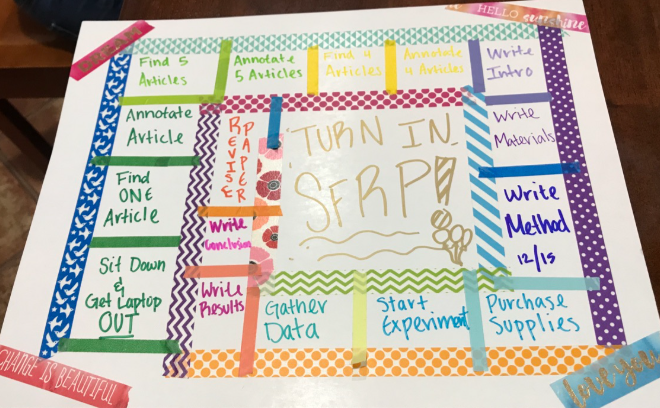
She worked. Just not on what needed to happen next. That same year, she spent weeks on a photography project. She shot the photos. She edited them. The final product was genuinely good. She never submitted it. It was not ready yet. It did not look the way she wanted it to look.
Three moments. Three different contexts. The same brain every time.
Perfectionism was part of what I was seeing and I want to be clear about that. But perfectionism as a surface behavior is where the observation begins, not where it ends. The real question — the one that changes everything about how you respond — is why. Why could she not commit to a decision on an activity designed to have no wrong answer? Why did the planning become the product? Why did finished work sit unsubmitted? That is where the detective work starts. And that is where the EF interplay comes in.
The Deeper Dive: Foundational EFs, Advanced EFs, and Why the Interplay Matters
One of the most important things to understand about executive functions is that they do not all operate at the same level. Some EFs are foundational — attention, working memory, cognitive flexibility, and task initiation. These are the building blocks. They are what the brain needs to be able to access before anything else can reliably happen. Then there are the advanced EFs — planning, organization, and time management. These are the skills we most often see struggling in the students we serve. They are also the skills most EF approaches jump straight to addressing.
Here is the piece most people miss. You cannot reliably build advanced EF skills on a foundation that is not yet solid. When a student is struggling with planning, organization, or time management, the question is never just what skill do they need. The question is what foundational EFs are working together underneath what I am seeing — and what is the interplay between them.
For this student, that question changed everything.
What looked like a planning problem with the game board was actually task initiation struggling against a working memory that was flooded with open decisions. What looked like an organization problem with the photography project was actually cognitive flexibility unable to shift from an idealized standard to a functional one. And what looked like a motivation problem with the candy activity was actually a brain holding so many possibilities open at once that committing to any single arrangement felt impossible without external validation.
This is the EF interplay in real life. The foundational EFs were struggling. And that struggle was showing up in what looked like advanced EF problems. When you only see the advanced EF — the planning, the organization, the time management — you respond to that. You bring in a planner. You create a checklist. You build a system. And when it does not work, you wonder why. The system was not the problem. The foundation was.
This is why understanding always comes before strategy in the Executive Function Interpretive Coaching Framework. Strategy is the destination. Understanding the unique brain in front of you — understanding which foundational EFs are at play, how they are interacting with each other, and what that interplay is producing on the surface — that is the starting point.
What This Means for the Unique Brain in Front of You
When you see perfectionism in a student, or what looks like a planning problem, or a student who works hard on the wrong thing, start with these questions.
Which foundational EFs are showing up here — is this a working memory issue, a task initiation issue, a cognitive flexibility issue, or some combination of all three?
How are those foundational EFs interacting with each other — is one making the others harder to access?
And what advanced EF does this look like on the surface — because that surface behavior is your entry point into the detective work, not your conclusion.
These questions do not have quick answers. But they are the right questions. And when you start asking them consistently, you stop responding to what you see and start understanding what is actually driving it. That shift — from reacting to understanding — is where real support begins.
We will be going much deeper into the foundational and advanced EF framework in July. For now, the most important thing to carry into your next session is this: the behavior on the surface is never the whole story. Ask why before you ask what. And trust that the answer — when you find it — will change everything about how you show up for the unique brain in front of you.
When Perfectionism Is Not the Whole Story: Understanding the EF Interplay
When we stop looking at the label and start looking at the interplay, everything about how we support a student changes. That is the foundation of the Executive Function Interpretive Coaching Framework, and it is at the heart of everything taught inside Mastering EF. If you are ready to go beyond the surface, two paths are open to you. Async at $995, or pre-register for the August cohort at $1,295 through July 31.
Real stories. Real science. Real understanding.