What to do when you're stuck on a student's executive function challenges
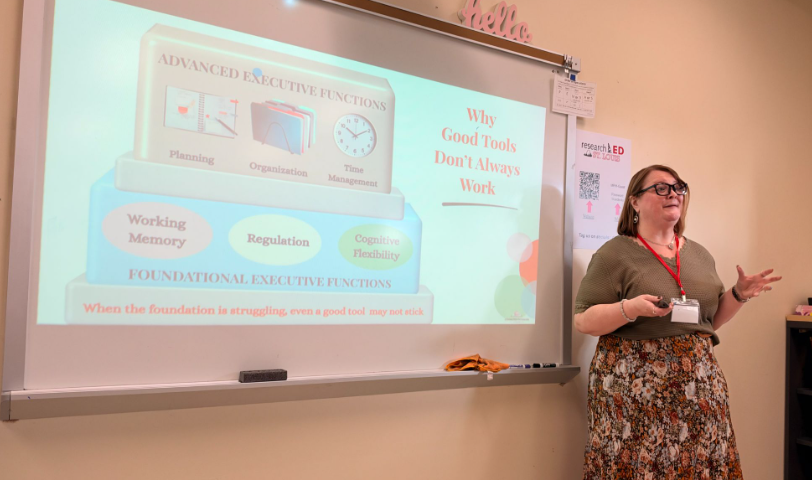
This past weekend I presented at researchED St. Louis, a conference where educators gather around the science of learning. My session, "The Executive Function Conversation That Changes How You See Your Students: Supporting the Brains Already Sitting in Your Classroom," was built for classroom teachers. But the ideas at the center of it are the same ones we work with every day in one to one coaching and tutoring. So I want to walk you through what I shared, and how you can bring it into your own work and to the teachers you partner with.
Meet Maya
Maya is a freshman in high school. She is bright. She participates openly in class discussions and answers questions with ease. She does well on tests.
But her written work comes back with the same comments again and again: too short, needs more detail. She has missing and late assignments, some of which end up crumpled at the bottom of her backpack. Some weeks she manages really well. Other weeks, she doesn't.
Have you worked with a student like Maya?
When I asked the teachers in my session what executive function might be contributing to her struggle with writing, the first answer was time management.
Why we go straight to the advanced executive functions
That answer is the one most of us reach for, and there is a good reason. Planning, organization, and time management are the executive functions we see on the surface. They show up as missed deadlines and messy backpacks, and they are the ones most often discussed. They are often what a parent names in the intake call, and what a student names when you ask what's hard.
They are also genuinely hard. Think about it. We have wedding planners, party planners, professional organizers, and administrative assistants. Entire careers are built around these advanced executive functions because they are not easy. And those are adults.
This is the piece most people miss: beneath those advanced skills sits a foundation of working memory, regulation, and cognitive flexibility. When the foundation is struggling, even a good tool may not stick. We can hand Maya a timer, a planner, or a new app, but if something underneath is getting in the way, the tool alone won't reach it.
For Maya, one possibility is working memory. To write, she has to hold on to what she wants to say while she is also forming sentences, spelling, and getting words onto the page. In a discussion, she only has to do one of those things. On paper, she has to do them all at once. That may be exactly why the ideas that flow so well out loud don't make it to the page.
It is only one possibility. That is the point. Before we choose a strategy, we look at the whole picture and ask what might be happening underneath.
Chunking through an executive function lens
Most teachers already chunk assignments, and most of us teach students to chunk too. A book project might look like this:
Read the book
Annotate important ideas
Create the presentation
That feels like 3 clear steps. But look at what each step asks of a student's brain.
"Read the book" means reading and remembering each chapter, keeping track of characters and details, and looking for important themes. "Annotate important ideas" means deciding what matters, connecting it to what you read, and capturing it in a useful way. "Create the presentation" means recalling what you read, finding the information you need, and choosing and organizing what to include.
That is not 3 steps. It is 9 separate demands, and nearly every one leans on working memory.
An executive function informed version keeps the same assignment and the same final product, but changes the rhythm. Instead of reading the whole book before annotating anything, the student cycles through read, annotate, and create a slide for each chapter, then finishes with read, edit, and present. Working memory only has to hold one chapter at a time instead of an entire book.
In the classroom, I encouraged teachers to tell students that some brains need tasks broken down even further in order to start them and finish them, and if that's you, go ahead and do it, and the teacher is happy to review it. A project planning form, with a row for each step, a column for when they'll do it, and a place to check it off, gives students a structure to do that on their own.
For those of us working one to one, this is where we shine. We can sit beside a student, look at the assignment they were given, and help them see the hidden steps inside each chunk. Over time, they learn to do that breakdown themselves.
Regulation and the hardest skill to ask for
The second foundational executive function I focused on was REGULATION, which I define as the ability to manage our thoughts, emotions, actions, and body so we can decide what to do next.
One place regulation shows up again and again is asking for help. It sounds like one skill, but it is a multistep process. A student has to notice they are struggling, identify what they are struggling with, decide whether they need help, manage the discomfort of asking, figure out how to ask, and then actually do it. Along the way, working memory and task initiation are pulled in too.
There is another layer. Dr. William Dodson has estimated that by age 12, children with ADHD receive about 20,000 more negative messages than their peers. I firmly believe this is often about how the feedback is perceived, not how it was given. Most adults are not trying to send a negative message. But students hear it, and they hold on to it.
I have worked with a medical student for several years now. When we first started, he would apologize for fidgeting. He would tell me he'd had a lazy day, or that he just wasn't motivated. He is a grown man in medical school, still carrying the messages he absorbed as a child.
I told him he had nothing to apologize for. For many students, especially those with attention challenges, movement can actually support focus and regulation. Research by Sarver and colleagues found that more movement during working memory tasks was linked to better performance for children with ADHD, and Hartanto and colleagues found that more intense movement was linked to better cognitive control in the moment. Zentall's optimal stimulation theory helps explain why: some brains need more stimulation to reach a regulated, alert state. That doesn't mean fidgeting helps every brain; in the general population it often travels with mind wandering. But it is a strong reason to be curious before we correct.
Does this sound familiar? How many of your students apologize for something their brain may actually need?
Green, yellow, pink: a private way to ask for help
So how do we make asking for help safer? One routine I shared with teachers takes less than a minute.
At a planned checkpoint, every student chooses a color and quietly highlights their name on their work:
Green: I understand and can keep going.
Yellow: I have a question.
Pink: I need help getting unstuck.
The teacher scans the papers while circulating or after collecting them, then responds privately with a quiet prompt, a written note, or a deskside check-in. Green needs no attention. For yellow, the student points to where they are unsure. For pink, you find the first step together.
The one rule: never call out the color. It is not a grade. It is a safe and private way to get help.
Back to Maya. She doesn't look dysregulated. We don't see her fidgeting or visibly stuck. But we don't actually know whether she is quietly struggling or unsure how to ask. What we do know is that the ideas she shares so well out loud aren't making it to the page. A private signal like this gives her a way to tell us, especially when she sits down to write.
This routine is designed for a classroom, but it's one you can share with the teachers of the students you support. It asks almost nothing of the teacher's time, and it gives your student a way to ask for help between your sessions.
What this means for our work
In a class of 30 students, a teacher has 30 unique brains, developing at different rates and meeting different demands. No teacher can write 30 executive function intervention plans, and they shouldn't have to.
That's where we come in. As coaches and tutors, we get to look at one unique brain at a time. We can be the ones who notice when a good tool isn't sticking and ask what might be happening at the foundation. And we can help the teachers in our students' lives see it too.
The more educators who understand executive function, the more support our students receive.
Looking at the foundation before you intervene
Seeing what's happening underneath starts with a clear picture of a student's executive function strengths and challenges. That's why on October 15 at 7 p.m. ET, I'm hosting Before You Intervene: Assessing Executive Function Skills, a live workshop where we'll work with two tools, the CEFI and the Frontal Skill Scan, and discuss how to make sense of what they show us. Community members are invited to attend as part of their annual membership, and everyone else can join us for just $197.
Join us for the WORKSHOP!
Oct 15 @ 7:00pm EST, WORKSHOP! - REGISTER!
Before You Intervene: Assessing Executive Function Skills