The EF Interplay Across Years: How Foundational Executive Functions Build the Foundation for Everything Else
We talk a lot about the importance of cognitive flexibility. So in the spirit of practicing what we teach, this newsletter is going to look a little different. Because the story I want to share with you happened across multiple years, the best way to tell it is to weave the story and the executive function lens together as we go. You will see the EF Interplay not just described but demonstrated. And when we get to the deeper part of the journey, we will take you to the blog where the story continues.
Have you ever worked with a student who could not hold a conversation without interrupting? Not because he did not care. Not because he was being disrespectful. But because his brain could not yet hold space for another person's words while managing his own.
That is where this story begins.
When I first started working with this student in sixth grade, the very first thing that became clear was that his attention was the foundation we had to build before anything else could happen. He would ask a question and then answer it before you could respond. He would start a thought and keep going long past the point where the conversation had moved on. He was not being difficult. His brain simply did not yet have the capacity to pause, listen, and wait.
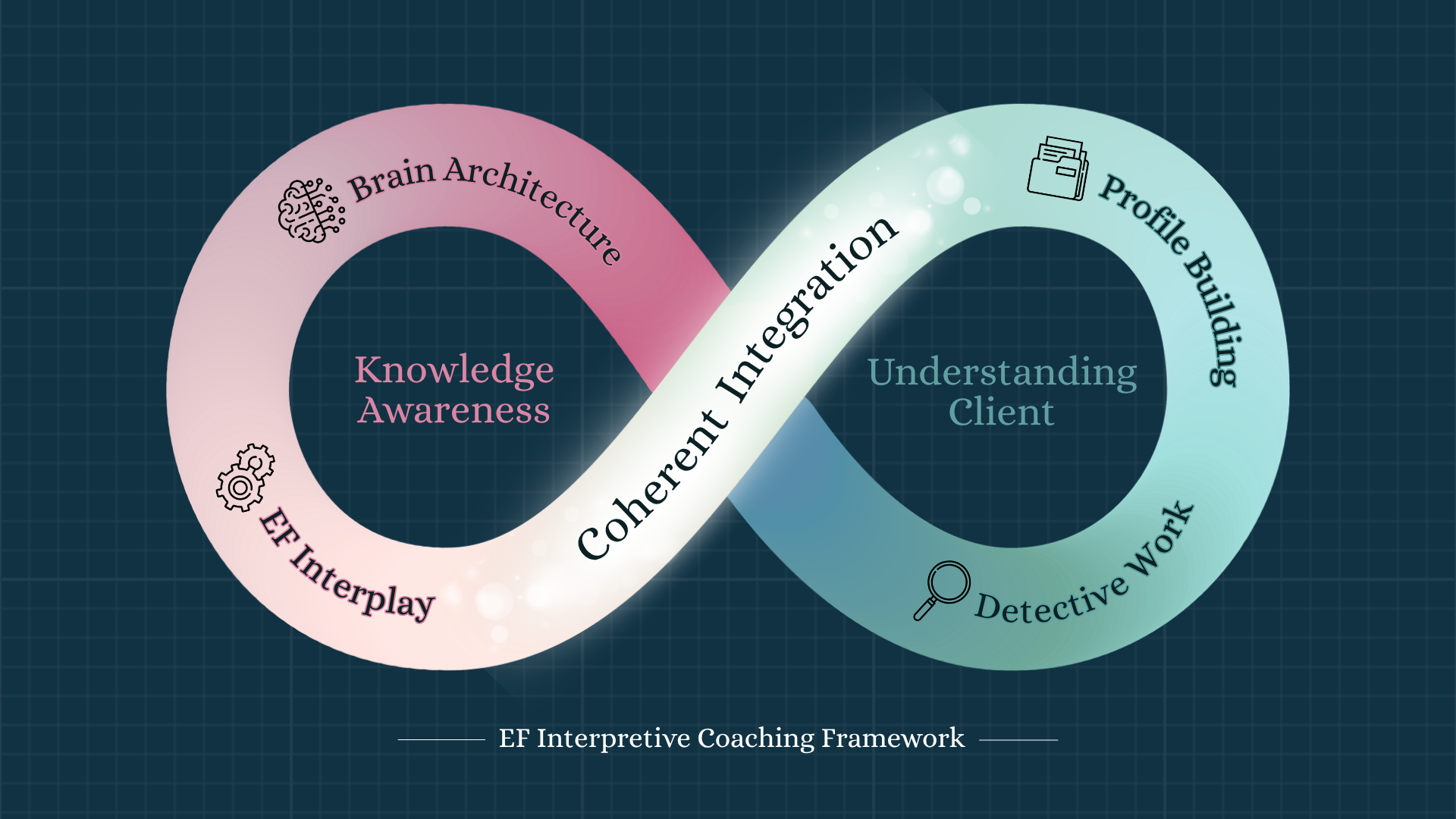
Attention is one of the 4 foundational executive functions in the Executive Function Interpretive Coaching Framework. Attention, working memory, cognitive flexibility, and task initiation are the building blocks. They are what the brain needs before advanced executive functions like planning and organization can reliably work. And for this student, attention was where we had to start. Before anything else. Before homework strategies. Before organization systems. Before planning tools. Attention first.
We introduced a visual timer so he could actually see time passing. We practiced taking turns in conversation. We built attention and communication skills at the same time because for this unique brain they were deeply connected. And slowly, steadily, his attention began to build.
Once attention was solid enough to work from, something else became visible. His working memory was struggling in a way that was making everything harder. He was coming home from school and not doing his homework. And the reason was not what it looked like on the surface.
His school portal was extraordinarily complex. Every teacher used a different system. His science teacher posted the most current assignments at the bottom of the page. His history teacher used folders within weeks within days. Every time he sat down to figure out what his homework was, his brain had to hold all of those different systems simultaneously, navigate each one differently, and then still have enough cognitive energy left to actually do the work.
By the time he figured out what his homework was, his brain was already exhausted.
This is the EF Interplay.
Working memory was flooding under the weight of too many systems. And that flood was triggering emotional dysregulation. His brain was so overwhelmed by the cognitive load of just finding his homework that regulation broke down before the homework even began. Attention, working memory, and emotional regulation were all working together, each one making the others harder. And on the surface it looked like he simply was not doing his homework
We brought his teachers together as a team. We created a simple sheet that each teacher could fill out so that when he got home, all of his homework was in one place. We removed the working memory burden entirely so that his brain could save its energy for the actual learning.
That was year 2. And it changed everything about what became possible next.
The Deeper Dive: When Foundational and Advanced EFs Work Together
Here is what most people do not realize about executive function development. It is never just one thing and even though it finishes developing around late twenties, early thirties; you technically can work on these skills your entire life. Even as we were addressing attention and working memory, we were also beginning to introduce advanced executive functions. Not because the foundational ones were perfect. But because life does not wait for perfect. A student still has to go to school. Still has to do homework. Still has to navigate a world that expects organization and planning, even when the brain is not yet ready to deliver them consistently.
So we began to work on both at the same time. And we did it in a way that always honored what we knew about his foundational EFs.
For organization, we introduced what we called the Z Case It. One single binder that held everything he needed for both his A schedule and his B schedule. The reason was simple. Every notebook he had to remember to grab was another demand on his working memory. One binder meant he always had everything. He never had to remember which notebook belonged to which day. The working memory burden of just being prepared for school was reduced to almost nothing.
Then we organized his binder the same way he had organized his candy in the candy activity. By color. He chose the color that represented each class. He chose an “out” folder for homework going out, and an “in” folder for homework coming back. His notes and returned work had their own folders. The system was his because he built it. And it was sustainable because it was built on an understanding of how his unique brain actually worked.
This is what the EF Interplay looks like when you are working on both foundational and advanced executive functions at the same time. You do not abandon the foundational work because you are introducing advanced skills. You let the foundational understanding shape how you introduce everything else. The organization system worked not because it was a good system in general. It worked because it was built for his brain specifically.
And then one day he said something to me that I have never forgotten. He said he did not know why I was still working with him because he was not making any progress.
He could not see what had changed because he was measuring himself against where he thought he should be, rather than against where he had started. He had forgotten that when we began he could not hold a conversation without interrupting. He had forgotten the portal. He had forgotten the year of building attention before anything else could happen. All he could see was what he still could not do.
This is one of the most important things to understand about executive function development. Progress is not always visible to the person living it. Real skill building takes time and it is not linear. We sometimes move forward and sometimes take a step back. And the student in the middle of that journey is often the last one to see how far they have come.
Think about the unique brain in front of you right now.
Think about where they started. Think about the foundational work you have done together before you ever introduced a strategy or a system. That work is real even when the student cannot see it. Your job is not just to build the skills. It is to help them see the foundation they are standing on.
That is the EF Interplay. That is what it looks like across years of real work with a real student. And that is what the Executive Function Interpretive Coaching Framework is built to help you do with every unique brain you work with.
The framework has always been woven through the Mastering EF Course, but we are now making it official. The Executive Function Interpretive Coaching Framework is one of the five core pieces that guides educators through the entire training. We have also added something new. The Prefrontal Power Up Cards and the Sidekick Workbook are now included with the course. These are physical tools that give you a concrete way to move through the framework and support the unique brains you work with. Because of these additions, the investment for the course has shifted. Starting August 1st, the cohort will be$1,597. This includes both the digital versions of the cards and the workbook. You also have the option to purchase physical copies if you want to hold them in your hands. But if you register now before August 1st, you can join at the current investment of $1,295 and receive the digital versions. You will have the option to upgrade to the physical deck and workbook whenever you are ready. Just use the coupon code “UPGRADE” The cohort begins August 10th. I hope you will join us.
Real stories. Real science. Real understanding.