Mental Health vs Mental Illness… and why this matters right now
May is Mental Health Awareness Month, so conversations around mental health are everywhere right now. And because of that, something I read this week stood out to me even more.
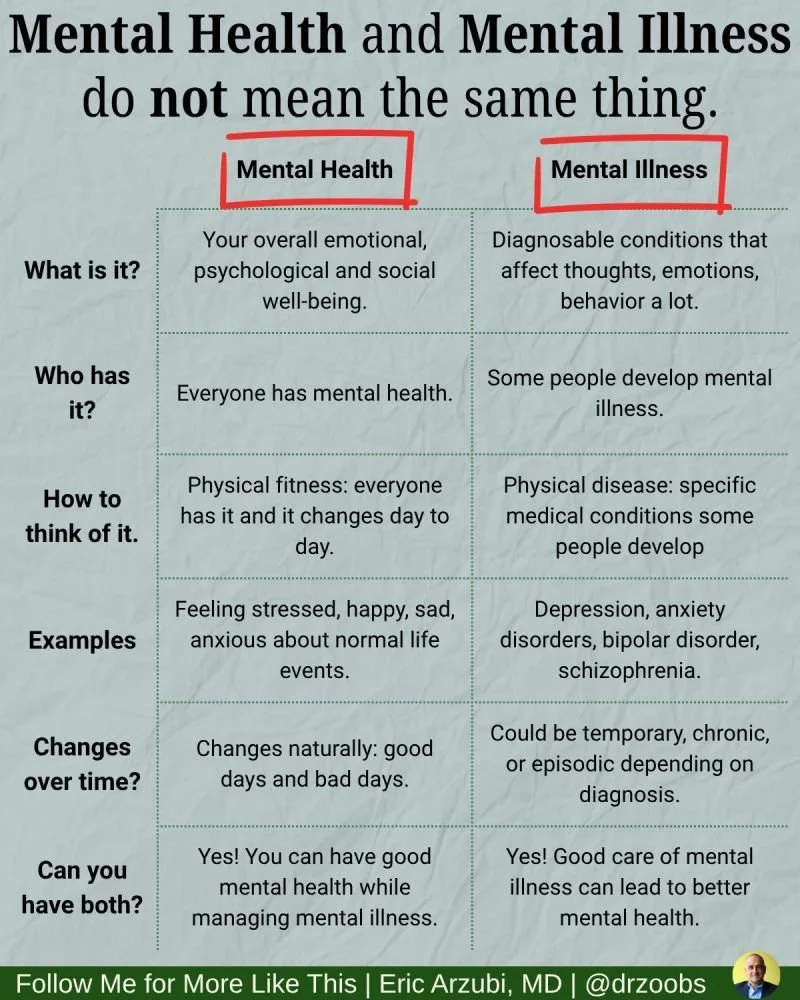
It was a post from psychiatrist Dr. Arzubi about how often we use the terms mental health and mental illness interchangeably.
And if I’m being honest… I’ve done this too. I think many of us have.
Because mental health feels safer. Less stigmatizing. Easier to say in everyday conversation.
But as I kept reading, I found myself pausing.
Because when we soften the language too much, we can also soften our understanding of what someone actually needs.
And this matters deeply when we’re supporting students.
Because when a student’s mental health is impacted, executive function is often one of the first things we see change.
They may suddenly struggle to:
get started
focus
remember what needs to be done
follow through
regulate emotions
From the outside, it can look like:
procrastination
avoidance
lack of motivation
But often, it’s not that the student has lost the skill.
They’ve lost access to the skill.
This is where the distinction Dr. Arzubi pointed out really matters.
Mental health is something we all have, and it can be impacted by life events
Mental illness may require clinical care, diagnosis, and treatment
Both matter. But they are not interchangeable.
The post I read shared examples of how serious conditions can be minimized when everything is labeled as “mental health.” And while I deeply understand the intention—to reduce stigma—the takeaway for me was this:
Clarity matters just as much as compassion.
Because:
Mental health is something we all have. It fluctuates.
Mental illness is a condition that may require clinical treatment.
Both are real.
Both deserve attention.
But they are not the same.
Scroll to the end to see Dr. Arzubi’s infographic*, which offers a powerful visual explanation of this idea.
How This Shows Up in Students
In my work, I often see students whose functioning suddenly changes.
A student who was managing just fine:
stops turning things in
can’t get started
struggles to focus
Sometimes this is tied to:
a breakup
a friendship issue
academic overwhelm
This is what I would describe as a temporary impact on mental health that affects executive function. A situational response to something happening in a student’s life.
But other times… it’s more than that. And that’s where we have to be careful.
Getting Clear
When a student’s functioning shifts, it’s easy to jump to conclusions.
Instead, I look for patterns:
1. Duration
Is this short-term and connected to a situation?
Or does it continue even after that situation has passed?
2. Intensity
Does it come and go… or feel constant and hard to shift?
3. Scope
Is it mostly showing up in one area (like school)?
Or across multiple areas of life?
4. Responsiveness
When support is added, does the student begin to re-engage?
Or does it feel like nothing is really changing?
How I Think About It
When something is situational, fluctuating, and responsive,
we’re often looking at a temporary impact on mental health affecting executive function.When something is persistent, widespread, and not shifting with support,
it may be a signal that additional, clinical support is needed.
This isn’t about diagnosing. It’s about noticing patterns early so we can respond with the right kind of support.
In both cases, one thing is consistently true:
When mental health is impacted, executive function is often the first system to be disrupted.
That shows up as:
difficulty initiating tasks
reduced working memory
decreased focus
challenges with follow-through
And from the outside, it can look like:
laziness
avoidance
lack of motivation
But underneath, it’s often a question of:
capacity, not willingness.
Why This Matters
If we blur the language, we risk mismatching the support.
We might:
offer strategies when clinical care is needed
or assume something is clinical when it’s actually situational
Neither serves the student.
This reflection shifted something for me. Not in a dramatic way—but in a more intentional one. The words we use matter. Because they shape what we see. And what we see determines how we support.
I’m especially excited to share that this is exactly the kind of conversation we’ll be diving into in an upcoming workshop.
On May 28th at 6:00 PM (EST), I’ll be co-hosting a workshop with therapist Ellina Creary from Harmony Counseling, who brings extensive experience working in adolescent hospitalization programs. 👉 REGISTER HERE!
The Hidden Struggle: When Mental Health and Academics Collide—A Guide for Coaches, Therapists, and Parents
Together, we’ll explore how to recognize what’s really going on beneath the surface and how to respond in a way that truly supports students.